Wolpé’s beautiful poems are at once sensual, meditative, raw in their honesty, and judicious in their fit use of language.  – Kwame Dawes, poet and critic
Wolpé’s concise, unflinching, and often wry free verse explores violence, culture, and gender.   
– Poetry Foundation
La poesía de Sholeh Wolpé no trata de encontrar el exilio, la feminidad y la rebeldía vía los conceptos. Los ve en el espacio sin nombre del cuerpo: en los olores, los colores y las voces. Y por eso, aun muy particular, es universal.   –Mohsen Emadi, Periódico de Poesía
A gifted Iranian-American poet beautifully explores love and the loss of love, beauty and war and the ghosts of the past.  –Shelf-awareness Magazine

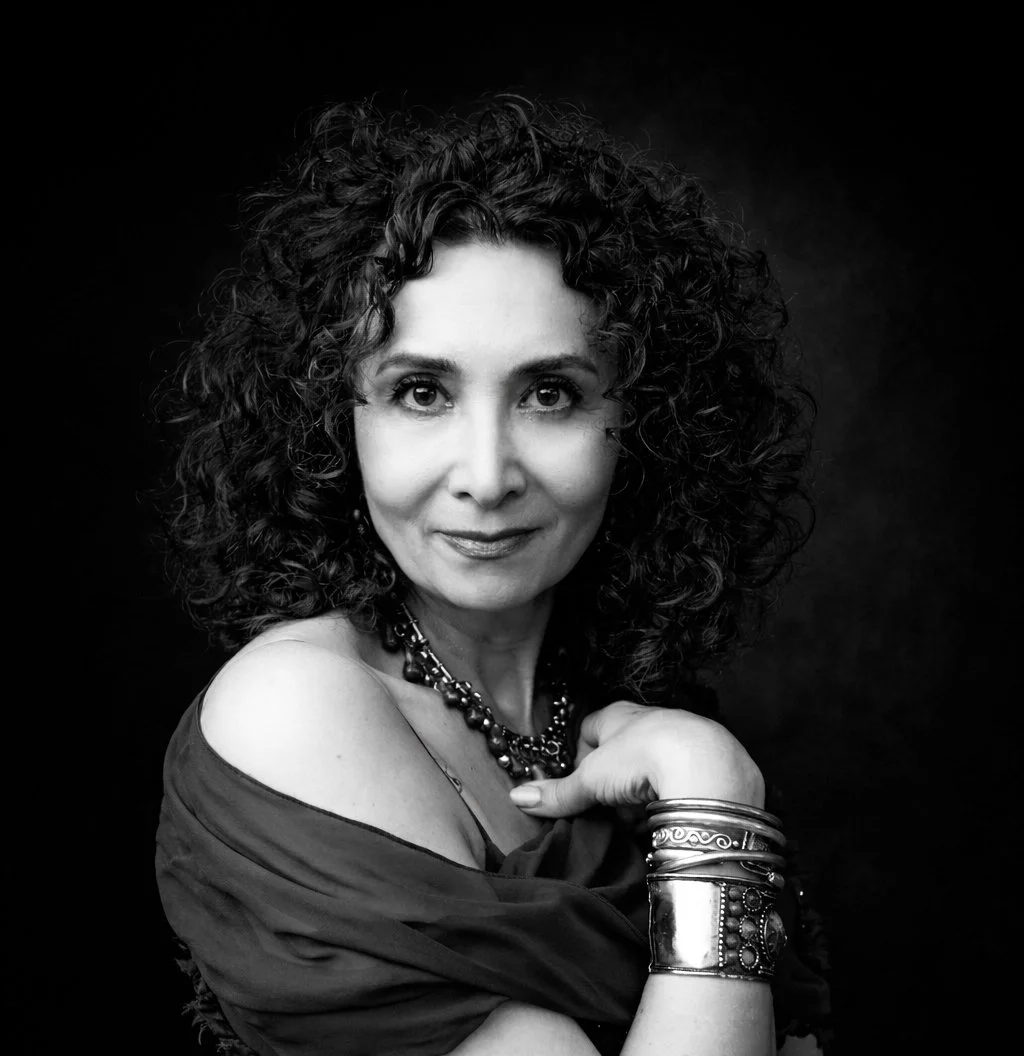
Sholeh Wolpé is an Iranian-American poet, writer, and librettist. Her literary work includes seven collections of poetry, several plays, five books of translations and three anthologies, as well as texts and librettos for the choir and opera.

Her most recent work include The Invisible Sun – Attar (Harper Collins), Abacus of Loss: A Memoir in Verse (University of Arkansas Press), Abaco de Perdida (Visor Libros, España), Song of Exile for choir and Nava Avaz, a full length opera for 6 composers (premiere 2027). Her translations of Iranian poetry, in particular 12th century Sufi mystic poet Attar, and 20th century Iranian rebel poet Forugh Farrokhzad have garnered awards and established Wolpé a as a celebrated re-creator of Persian poetry into English.

She is the recipient of Opera America Discovery Award as well as a PEN/Heim, Midwest Book Award, and the Lois Roth Translation Prize. Her book, The Invisible Sun, was on PEN America award 2025 Long List. She is the Writer-In-Residence at the University of California, Irvine (UCI). She has lived in Iran, Trinidad, and United Kingdom and presently divides her time between California and Barcelona.

Prism International writes that in Wolpé’s memoir in verse, Abacus of Loss, “desire and love exist in terrifying worlds” yet they are handled with “silken language.” Abacus of Loss was chosen by The Mary Sue magazine as one of “8+ Beautiful, Contemporary Novels Written in Verse That Make Poetry Accessible,” and was hailed by Colorado Review as a book that “examines the masks of patriarchy in powerful metaphor and narrative.”

Her translations of Iranian poetry include: The Forbidden- Poems from Iran and Its Exiles (Michigan State Univ. Press), The Conference of the Birds (W.W. Norton & Co), The Invisible Sun (Harper Collins) and 20th century Iranian rebel poet Forugh Farrokhzad,  Sin: Selected Poems of Forugh Farrokhzad (Univ. of Arkansas Press).

As lyricist/ librettist, she has written for Fahad Siadat (U.S), Ramin Amin Tafreshi (Netherlands), Huba de Graaf (Netherlands), Aida Shirazi (Canada), Sahba Motallebi (U.S./ Iran), Niloufar Nourbakhsh (U.S.), Sahba Aminikia (U.S./ Iran), Shawn Crouch (U.S.), and Chris Gordon (U.S.) among others.

Wolpé wrote the libretto for The Conference of the Birds—A Movement-Driven a Cappello Oratorio, composed by Fahad Siadat, and Choreographed by André Megerdichian. It premiered at the Broad Stage in Los Angeles in June 2022 to sold out audiences. Her new libretto, Nava Avaz, was the recipient of 2025 Opera America Discovery Grant.

Wolpé’s multi-discipline performance piece The Seven Valleys combined poetry, dance, music and projection art. It was commissioned by The Getty Villa Museum and performed there on July 16, 2022.

Wolpé’s plays have been produced by Oakland Theater Project, Inferno Theater, Northern Illinois University, and The Alternative Theater company, among others, and have been finalists and semifinalists at Bay Area Playwrights Festival, Eugene O’Neill National Playwrights Conference, Centenary Stage Women Playwrights, Ojai Playwrights Festival, and Ashland New Plays Festival. Her play LET ME IN is among Theaterfolks’ top ten plays requested by schools. Her play SHAME is one of the features plays in New Iranian Plays, published by Auroa Metro books (2022) and was shortlisted for the Cooper Prize in Australia.

Sholeh has performed her literary work with world-renowned musicians at Quincy Jones Presents series at The Edye, Skirball Cultural Center Series, Los Angeles Aloud, The Broad Museum, LA County Museum of Art Ahmanson stage, Singapore Literature Festival, UNSW School of Arts and Media theater in Sydney, Jaipur Literature Festival, Kala Khoda Festival in Mumbai, Tasmania Art Center, Brisbane jazz stage, as well as other venues in China, Spain, India, UK, the US.

She has lived in Iran, Trinidad and the UK, and presently divides her time between California and Barcelona. Sholeh is married to sociologist Edward Telles and is presently a Writer-in-Residence at the University of California, Irvine.  


Reinventar la infancia
Sobre la poesía de Sholeh Wolpé

por: Mohsen Emadi


1.
Pocos días después de la revolución en Irán, comenzaron los primeros movimientos contra los ayatollahs. El primer grito fue el de las mujeres. En un ambiente de ambigüedades, dudas y retóricas políticas del momento, las mujeres sabían que el destino estaba por llegar. Los olores, los colores y las voces revelaban más la identidad de un régimen político que las palabras. La historia de la resistencia de las mujeres iraníes contra los regímenes totalitarios, de monarcas o islamistas, sigue siendo vigente hasta casi dos siglos después. Las poetas siempre estuvieron en la primera línea de esta lucha. En el amanecer de los movimientos libertarios de Irán, que luchaban contra el dogma religioso y la monarquía, aparece la figura de una poeta que también tiene aspectos mitológicos. Un mito que se forma en el siglo XIX y es creído. Táhirih (1814 o 1817-1852) fue parte de los fundadores de una nueva religión en Irán, que construyó una mezcla mística del islam con el cristianismo, zoroastrismo y budismo. Desde el inicio, esta religión fue perseguida por los islamistas. Táhirih, además de ser considerada como una teóloga, es poeta y es la primera mujer en Irán que se quitó su velo en público. La mujer que había perdido su subjetividad, de repente la obtiene por la luz de su cuerpo. En Irán, sin duda, la subjetividad del pensamiento pertenece a la poesía. La imagen de Táhirih se parece mucho a la de Sor Juana. Sholeh Wolpé dedica adrede parte de su trabajo de traducción a esta figura. Wolpé trata de trasladar la historia de la conciencia femenina en la lengua persa hacia otra lengua que ya es su casa de existencia: el inglés. Wolpé, aun nacida en Irán, escribe su poesía en inglés.

2
A pesar de que muchos escritores emigran de un lenguaje al otro, Wolpé no realiza una emigración, en cambio ella domina el inglés con propiedad. Es decir, no permite que el lenguaje del imperio devore su subjetividad, es ella la que obliga al imperio a pensar en ella. En el siglo XX fueron muchos los escritores que eligieron una lengua distinta del idioma de su infancia como el lenguaje de su poesía. Por ejemplo, Jean Portante, el poeta de Luxemburgo, nacido en Italia, escribe en francés. Portante inventó una metáfora muy interesante que se puede utilizar acá. Dice: La ballena es el único animal del mar que tiene pulmones. La ballena fue una criatura de la tierra pero con el tiempo debería moverse al mar para sobrevivir. Poco a poco perdió todos sus miembros y se convirtió en un pez, con una excepción, todavía tiene un solo órgano de su época terrestre: los pulmones. Portante habla de su poesía utilizando esta metáfora. Cree él que el ritmo y la respiración en su poesía vienen del italiano pero otros miembros de ella son franceses. Se puede utilizar la misma metáfora hablando de la poesía de Sholeh Wolpé. La poesía nace originalmente como la música y, según Antonio Gamoneda, la poesía es el pensamiento rítmico.
Por eso el pensamiento revoluciona cuando obtiene otro ritmo, en este caso el ritmo de otra lengua.


3
La traducción es una parte inseparable del oficio poético de Sholeh Wolpé. En inglés, Wolpé excava tres dimensiones de su vida por la traducción y profundiza en ellas: el exilio, la feminidad y el misticismo. El misticismo, que en sí es una experiencia poética, juega un papel importante en la historia del pensamiento, afrontando el monopolio de lo divino. Ilan Berk escribió: solo los poetas tienen una infancia más larga. Es decir, Wolpé, cuando traduce un poema, traduce su infancia en lengua persa a su infancia poética en lengua inglesa. Hace la traducción de una infancia a otra, de un asombro a otro. Sin embargo, entre estos dos entornos de la subjetividad, vive en el abismo. El abismo entre "yo" y "yo" es el mismo abismo donde reside el motor de la subjetividad poética.

4
María Zambrano pensaba que la poesía es un movimiento contra la esperanza de la razón. Sabemos después por Schopenhauer que la razón es un fenómeno masculino y funciona con las tácticas de las guerras. Nietzsche imaginaba que antes de Sócrates existían tres tipos de mujeres: mujer como mujer, mujer como verdad y mujer como mentira. Y según Nietzsche después de Sócrates la mujer como mujer desapareció. Mujer como verdad o mentira es una mujer encarcelada en la dualidad platónica. La poesía, en cambio, lucha contra todos los fundamentos de esta dualidad: la categorización, reducción y extensión, las analogías, etcétera. En la poesía regresamos al nacimiento de las palabras, donde el cuerpo todavía no tiene nombre y no es un objeto político-social. La poesía de Sholeh Wolpé no trata de encontrar el exilio, la feminidad y la rebeldía vía los conceptos. Los ve en el espacio sin nombre del cuerpo: en los olores, los colores y las voces. Y por eso, aun muy particular, es universal. Como señala Ryokan: "Lo particular y lo universal son las dos caras de una misma moneda".

In a world where cultures and religions are recklessly facing off, Sholeh Wolpé writes careful poems that cast a light on some of what we all hold in common.” –Billy Collins, Poet Laureate United States

“Sholeh Wolpé, a poet and artist in her own right, Iranian-born and cosmopolitan, is a daughter of the freedom made possible by poets like Farrokhzad. Her translations are hypnotic in their beauty and force.” – Alicia Ostriker, poet, critic, Chancellor of the Academy of American Poets

“Sholeh Wolpé’s poems are political, satirical, and unflinching in the face of war, tyranny and loss. Talismanic and alchemical, they attempt to transmute experience into the magic of the imagined. But they also dare to be tender and funny lyrical moments.” –Chris Abani, poet and novelist

“So much to love here in this brave and vivid music of storytelling. I for one admire how much Sholeh Wolpé loves our days, how much tenderness and insight, each moment’s turn offers. There is much gusto, too, and such style and verve. ‘Make my curly hair your flag,’ the poet tells us, as she guides us on the trip via ‘boats crusted with stories.’” –Ilya Kaminsky, National Book Award Finalist

“Through her translations of Iranian writers, and through four collections of her own poetry, Wolpé seeks to bridge the fierce political divide between her native Iran and her adopted Western homes—to pierce their mutual ignorance, and reveal one to the other.” –Guernica, A Magazine of Global Arts and Politics

“Sholeh Wolpé provides generous service in showing readers the different ways that poets commit to their own voices as they call out The Deadly Silencer, sounding off in a world that does not listen, indifferent to their commitment.” –Huffington Post

“In this beautiful rendering of Attar’s Conference of the Birds, Sholeh Wolpé, herself a passionate poet, transports us to another time, another language & another world, while reminding us of how enduring & universal great works of imagination are, how they create spaces within which we not only acknowledge and appreciate our differences but also recognize & celebrate our shared humanity. Only a true poet could achieve such a feat.” –Azar Nafisi, author of Reading Lolita in Tehran

“Wolpe’s poems are at once humorous, sad and sexy, which is to say that they are capriciously human, human even in that they dream of wings and are always threatening to take flight.” –Tony Barnstone, poet

“Sholeh Wolpé’s poetry proves to be rumination, prayer, song.” –Nathalie Handal, poet and essayist

“Sholeh Wolpé’s poems confirm the positive reaction that I have had to her work–the irrepressible originality, the insouciant wit, the occasional stabs of pain, the fearless honesty, the instant evocation of a time and a place are all here in an enjoyable and endearing mix.” –Amin Banani, Professor Emeritus of Persian and History, UCLA

“Wolpe's righteous aversion to male oppression is as broad as the span from Tehran to LA, as deep as a wise woman’s heart.” – Richard Katrovas, Poet, novelist, Western Michigan University

“I read an advanced copy of Sholeh Wolpé ’s translation of the twelfth-century Persian masterpiece The Conference of Birds. It is a beautiful work and a beautiful translation. One of Sholeh Wolpé ’s strengths as a translator is that she is also a poet with a fine ear for English and she brings her feeling for language into her translations.” –Peter Constantine, in an interview in The Center For Fiction

“Sholeh Wolpé’s exquisite poetic voice and her superb command of the art of translation meld together in translations that exude passion, defiance, and crackling wit.” –Nasrin Rahimieh, University of California, Irvine